
In an era where artificial intelligence is no longer a futuristic concept but a business imperative, the Enterprise AI Platform has emerged as the cornerstone of digital transformation. Organizations worldwide are racing to integrate AI into their core operations, and the numbers tell a compelling story. According to Gartner, worldwide end-user spending on AI models and platforms is projected to total $64 billion in 2026, representing a staggering 63.4% growth from $39 billion in 2025.
What Is an Enterprise AI Platform?
-
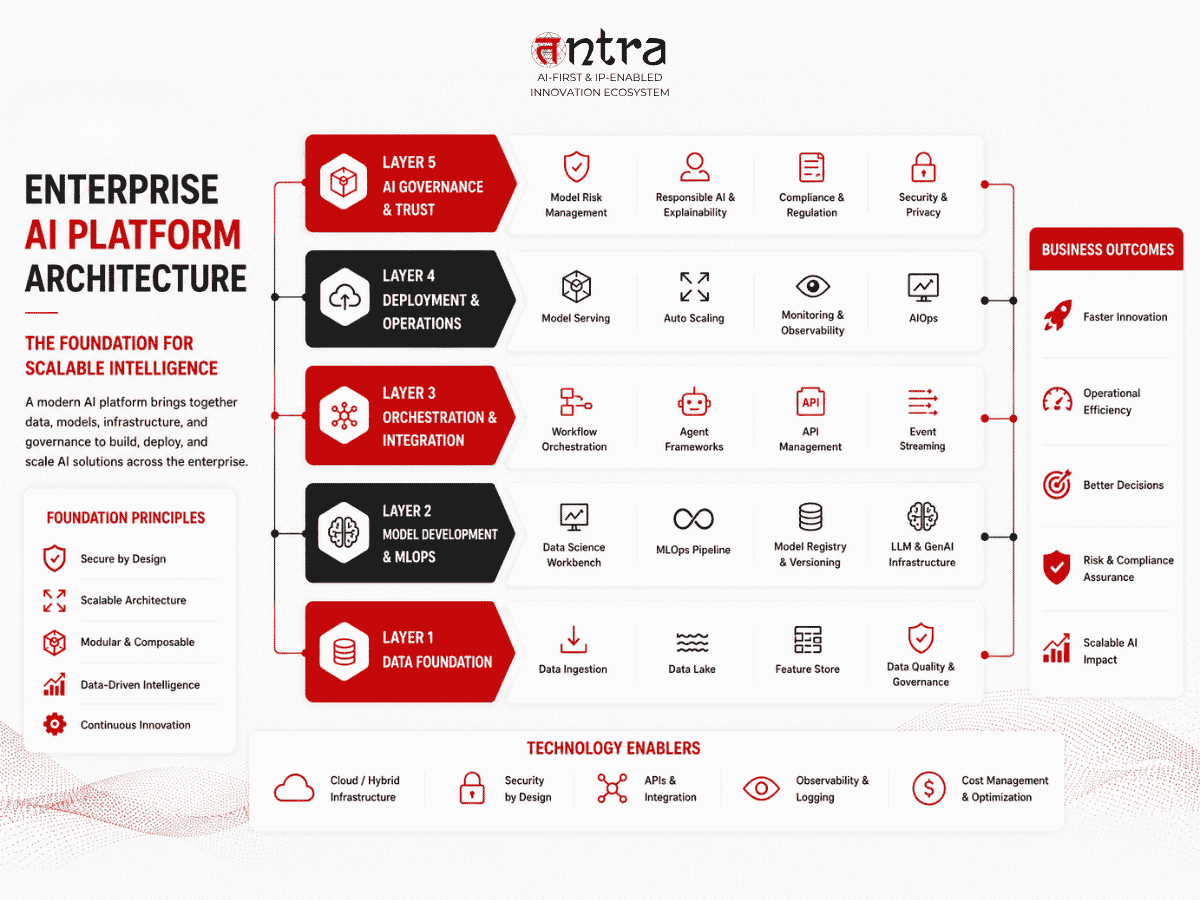
Data Foundation Layer: Unified data ingestion, lakes, feature stores, and quality governance
-
Model Development & MLOps: Data science workbenches, training pipelines, model registries, and versioning
-
Orchestration & Integration: Workflow automation, API management, and agent frameworks
-
Deployment & Operations: Model serving, auto-scaling, monitoring, and AIOps
-
AI Governance & Trust: Risk management, explainability, compliance, and security
Why Enterprise AI Platforms Are Critical in 2026
1. From Experimentation to Production at Scale
2. Democratization of AI Development
Low-code and no-code capabilities embedded within modern platforms empower business analysts, department managers, and subject matter experts to build AI solutions without deep computer science expertise.
This democratization accelerates innovation while reducing dependency on centralized IT resources.
3. AI Governance and Compliance
4. Cost Optimization and ROI Measurement
With AI budgets under greater scrutiny, enterprises demand transparency. Leading platforms now embed evaluation, cost transparency, and usage tracking directly into customer workflows, making it easier to manage and optimize AI spend.
Key Features of a World-Class Enterprise AI Platform
End-to-End ML Lifecycle Management
A robust platform must support the complete machine learning lifecycle—from data preparation and feature engineering to model training, hyperparameter optimization, deployment automation, and production monitoring.
Multi-Cloud and Hybrid Deployment
Modern enterprises operate across complex infrastructure landscapes. The best platforms provide consistent AI capabilities across public cloud providers, private data centers, and edge environments. Hybrid deployment models are gaining significant traction as enterprises require cloud-based development combined with on-premises deployment for latency-sensitive and data-residency-constrained applications.
Agentic AI and Workflow Automation
2026 marks the rise of agentic AI—autonomous systems that take initiative, make decisions, and execute complex workflows with minimal human intervention.
Enterprise platforms now support the creation and orchestration of these digital agents, enabling true machine automation across procurement, customer service, IT operations, and more.
Domain-Specific Model Support
While general-purpose large language models captured early attention, 2026 is the year of specialization. Domain-specific language models (DSLMs) are forecast to grow 210% in 2026, outpacing general model adoption.
Leading platforms support both general and specialized models, allowing enterprises to optimize for accuracy, latency, and cost.
Comprehensive AI Governance
From model risk management and responsible AI explainability to compliance regulation and security privacy, governance capabilities are now table stakes.
Multimodal AI Capabilities
The convergence of text, image, video, audio, and structured data analysis enables unprecedented business intelligence. Multimodal AI systems process information holistically, uncovering insights that single-mode analysis misses entirely.
Top Enterprise AI Platforms in 2026: The Competitive Landscape
Microsoft Azure AI
Microsoft maintains market leadership through its comprehensive Azure AI platform, combining cloud infrastructure, machine learning services, and OpenAI integration.
Azure AI Foundry provides a unified environment for developing, customizing, and managing AI applications and agents. Its deep integration with the Microsoft 365 ecosystem makes it particularly attractive for enterprises already invested in Microsoft’s stack.
Google Cloud Vertex AI
Google competes through Vertex AI, offering strong model training, AutoML capabilities, and robust data engineering tools. The platform emphasizes AI security, data protection, and ethical AI principles.
AWS (SageMaker + Bedrock)
Amazon’s modular approach combines SageMaker for traditional machine learning with Bedrock for foundation model access and generative AI building blocks. AWS offers breadth across storage, compute, networking, and security, making it ideal for cloud-first enterprises with platform engineering maturity.
IBM Watsonx
IBM’s Watsonx distinguishes itself through hybrid deployment capabilities and a sharp focus on governance and compliance. It provides access to pre-trained foundation models while enabling deployment across cloud and on-premises environments.
Databricks Mosaic AI
For organizations standardizing on the lakehouse architecture, Databricks offers tightly coupled data and AI workflows. Its practical path from analytics to production AI makes it a favorite among data platform-led organizations.
DataRobot
DataRobot democratizes AI through automated machine learning, composable AI apps, and explainable AI (XAI) tools. It supports diverse deployment options including SaaS, dedicated cloud, and on-premises configurations.
Major Trends Shaping Enterprise AI Platforms in 2026
The Rise of Agentic AI
Agentic AI represents a paradigm shift from reactive tools to proactive digital employees. These autonomous agents manage multi-step processes across different systems, handling everything from customer service escalations to complex data analysis.
Innovations like MCP servers and A2A protocols have matured into common foundations, removing friction from enterprise deployment.
Sovereign AI and Data Control
Governments, regulated industries, and large enterprises are accelerating investments in sovereign AI to retain control over data, models, and infrastructure. This addresses growing concerns around security, governance, and compliance.
Embedded AI as Invisible Infrastructure
AI is becoming woven into the fabric of business applications rather than existing as standalone tools. CRM systems automatically generate insights, project management platforms predict delays, and collaboration tools surface relevant information contextually.
AI Factories and Industrial Mindset
Organizations are adopting an industrial mindset to developing and running AI at scale. Purpose-built platforms accelerate all stages of the AI workflow, treating AI development as a production pipeline rather than a craft activity.
Edge AI Expansion
Enterprises continue bringing intelligence closer to where data is generated. Edge AI addresses low latency requirements, bandwidth limitations, and privacy concerns—particularly in manufacturing, healthcare, and autonomous systems.
How to Choose the Right Enterprise AI Platform
1. Assess Your Data Landscape
2. Evaluate Deployment Flexibility
3. Consider Your Team’s Expertise
Platforms with strong low-code/no-code capabilities empower broader teams, while code-first environments suit organizations with deep data science expertise. Azure AI, for example, caters to users across all skill levels—from non-technical business users to expert data scientists.
4. Prioritize Governance and Security
5. Calculate Total Cost of Ownership
Look beyond licensing fees. Consider infrastructure costs, integration effort, training requirements, and ongoing maintenance. Usage-based pricing models are becoming standard, making cost transparency essential.
6. Verify Ecosystem Integration
Implementation Best Practices for Maximum ROI
Start with High-Impact Use Cases
Establish a Center of Excellence
Create a cross-functional team comprising data scientists, engineers, business analysts, and governance experts. This center of excellence provides training, templates, and standards while empowering citizen developers.
Implement Tiered Governance
Apply different governance levels based on risk profiles. Low-risk applications like content recommendations receive lighter oversight, while high-risk systems involving financial decisions or personal data undergo rigorous review.
Invest in Change Management
Monitor and Optimize Continuously
The Future of Enterprise AI Platforms
Interconnected AI Ecosystems: Individual AI systems will increasingly collaborate, sharing context and insights across business functions to deliver compound value.
Open Source Diversification: Global model diversification, interoperability standards, and hardened governance will define open-source AI. Chinese multilingual models and reasoning-tuned releases will push the boundaries of capability.
Human-AI Collaboration: The most successful enterprises will treat AI as a collaborative partner rather than a replacement. Human judgment remains essential for training, validating, and refining AI systems.